
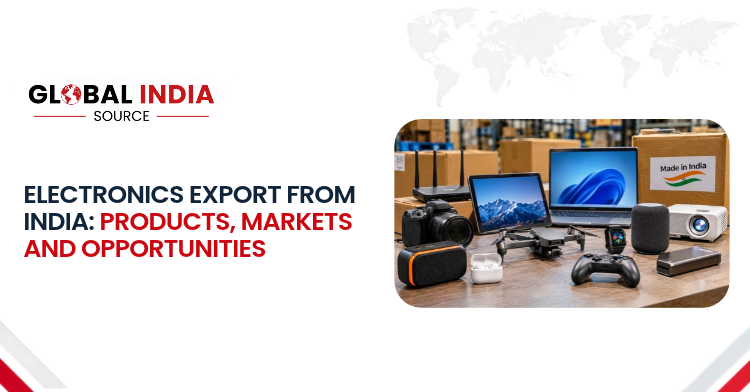
In the past few years, there has been considerable development in India’s electronics manufacturing industry, placing the nation on a promising path to become an essential supplier for electronics products globally. Right from consumer electronics to components used in making industrial machinery and devices, the electronics manufacturers of India have emerged as major suppliers for various technological products across the globe.
According to IBEF, the total exports of India’s electronic goods amounted to US$47.96 billion during FY 2025-26, up by 24.39% over the last fiscal year. This has been possible owing to the enhanced capabilities of domestic manufacturers and increased demand for Indian products abroad.
International buyers who wish to source electronics from India can benefit from the growing manufacturing capabilities, competitive production processes and varied product categories. The following guide will discuss the leading electronics products, export markets, overseas buyers and the process of exporting electronics from India in 2026.
Why Is India Gaining Prominence as a Leading Destination for Exporting Electronics?
The development of India as an export market for electronics depends on manufacturing investments and government programs along with involvement in global supply chains.
Among some of the reasons why India is becoming an exporter of electronics can be named:
- Rise of the manufacturing industry: Electronics production rose from about ₹1.9 lakh crore in FY 2014-15 to ₹13.11 lakh crore in FY 2025-26.
- Initiatives of the government: Programs such as Make in India, Production Linked Incentive (PLI) and Electronics Component Manufacturing Scheme (ECMS) encourage manufacturing and investments.
- Technical workforce: India’s engineers and technical knowledge help with electronics assembling, manufacture and development of products.
- Diversifying supply chain: International companies look for other places for manufacturing to diversify their supply chain.
- Investments in components: Investments in semiconductors, printed circuit boards and electronic sub-assemblies develop manufacturing capacity in India.
It creates good conditions for exporters of electronics in India.
Top Electronic Products Exported from India
India manufactures and exports many different categories of electronic products.
- Consumer Electronics
Consumer electronics comprise one of the most significant sections of India’s manufacturing sector. The products consist of televisions, audio products, home entertainment products, smart appliances and wearables.
International requirement for low-cost and technologically advanced consumer devices presents opportunities for Indian manufacturers and suppliers.
- Electronic Components & Printed Circuit Boards (PCBs)
Electronic components are the base of any modern electronic product. India manufactures products like printed circuit boards (PCBs), connectors, resistors, capacitors, transformers and electronic assemblies.
Growing domestic component manufacturing ecosystem has created opportunities for export of electronic components from India for international manufacturers.
- Computer Hardware and Accessories
Computer hardware manufacturing in India comprises laptops, tablets, servers, computer accessories and other related products.
Support of the Government of India through PLI Scheme 2.0 for IT Hardware is leading to development of the sector.
- Electrical Equipment & Power Electronics
Power electronics and electrical equipment are used across various industrial, commercial and infrastructure applications.
Some of the key products in the sector include power supply units, inverters, transformers, voltage regulators, control panels and power conversion products.
- LED Lighting and Electronic Accessories
LED light products are in high demand globally owing to their energy conservation capacity and longer service life.
The Indian companies manufacture LED bulbs, light fittings, drivers, electronic adapters, chargers and accessories which are then sold internationally.
- Industrial Electronics and Automation Equipment
Industrial electronics facilitate production, infrastructure, and automation processes.
This category comprises PLCs, sensors, electronic control systems, monitoring and automation products.
There are several prospects available to the Indian manufacturers catering to the specialisation of equipment to the international market.
Top Countries Importing Electronics from India
India’s electronics exports reach several developed and emerging markets. According to the latest available Q1 FY 2026–27 trade data, the leading destinations for Indian electronic goods include:
| Country | Export Market Opportunities |
| United States | Smartphones, electronic equipment and components |
| United Arab Emirates | Consumer electronics and electronic accessories |
| China | Electronic components and intermediate products |
| Hong Kong | Mobile phones and electronic components |
| Netherlands | Electronic equipment and components |
The United States was still the top importer of electronics from India for the quarter ending June 2026, followed by UAE, China, Hong Kong and Netherlands.
Others may include Germany, United Kingdom, Singapore and others in Europe and Asia.
The exporters looking for destination countries to export their electronics have to consider the demand from the destination countries, import duty rates, standards and competition.
Who Are the Major International Buyers of Indian Electronics?
The international buyers of Indian electronics are various companies working in different sectors.
Some of the major groups of buyers are:
- Original Equipment Manufacturers (OEMs): The companies buying the electronic parts and assemblies used in their products.
- Electronics Distributors: The companies buying the products in large quantities for further distribution in the region.
- Retailers and Wholesalers: The companies importing consumer electronic goods, accessories and electric goods.
- Contract Manufacturers: The companies buying the electronic parts and sub-assemblies for electronics manufacturing.
- Industrial Businesses: The manufacturers buying automation equipment, sensors, control equipment and power electronics.
- Technology companies: The companies buying computer hardware and communication equipment.
Why Should Global Buyers Source their Electronics from India?
Buyers from around the world are looking towards India as an ideal source due to its manufacturing capabilities and product range.
Important benefits include:
- Effective manufacturing: Suppliers from India provide manufacturing capabilities at varying prices and production ranges.
- Product range: The buyers can source finished electronic products, components and industrial equipment.
- Support for manufacturing expansion: Programs by the government support manufacturing investments.
- Increasing network of suppliers: Business organizations can link themselves with manufacturers, components suppliers and contract manufacturers.
- Connectivity to global trade: India is well-linked with respect to exports.
But the buyers must check for certifications, manufacturing capacity and compliance on their own.
Steps Involved in Exporting Electronic Products from India
There are a few things you need to do before starting electronics export business from India.
Step 1 – Select the Right Electronic Products
Identifying the right electronics products will be the first step in your electronics export business.
You will need to research the market needs and specifications of products, their HS code, the import policies of the target market countries and the level of competition. Identify if your chosen products have sustainable margin.
Step 2 – Identify Reliability Electronics Manufacturers and Suppliers
Identify manufacturers who will meet international requirements for quality and production of products.
Assess their manufacturing facilities, samples of their products, their capacity, their prices, their certification details and their past experience with exports.
Companies can make use of B2B portals and trade fairs to find the right Indian suppliers.
Step 3 – Register Your Business and Get IEC
Complete the registration of your business and obtain the relevant tax registrations.
You will need to obtain Importer Exporter Code (IEC) which is issued by Directorate General of Foreign Trade (DGFT).
Step 4 – Know about Product Standards and Certifications
There are certain Indian standards and importing country’s standards to which electronics exports have to conform to.
Depending upon the kind of product, the exporter would require BIS certification, safety testing, electromagnetic compatibility (EMC), WPC certification for certain wireless products and destination specific certification.
The products being exported to the European Union countries would also require compliance with CE marking standards wherever applicable.
Step 5 – Finalize Pricing and Commercial Terms
Work out total cost of exports from India including manufacturing, packaging, transport cost, insurance cost and applicable taxes.
Fix the terms of payment and delivery along with Incoterms like FOB, CIF and FCA with the foreign buyer.
Step 6 – Generate Required Export Documents
Generate commercial invoice, packing list, shipping bill and transport documents.
Depending upon the destination and category of product, other documents such as the certificate of origin, inspection certificate and insurance certificate could also be required.
Step 7 – Organize Shipping and Customs Clearance
Select a suitable shipping process taking into consideration the value, weight, shipping requirements, and destination of the goods.
Work together with the freight forwarders and customs brokers to organize the shipping and customs clearance processes.
In case of delicate electronic products, ensure proper packaging and handling of the goods during transportation.
Documents Needed for Export of Electronic Goods from India
Usually exporters require the following documents:
| Document | Purpose |
| Importer Exporter Code (IEC) | Identifies the exporter for international trade |
| Commercial Invoice | Provides product details, quantity and transaction value |
| Packing List | Specifies packaging, dimensions and shipment weight |
| Shipping Bill | Required for customs export clearance |
| Bill of Lading/Airway Bill | Serves as the shipment and transport document |
| Certificate of Origin | Identifies the country where goods originate |
| Insurance Certificate | Provides evidence of shipment insurance, where applicable |
| Inspection Certificate | Confirms product quality or inspection requirements, where applicable |
| Product Compliance Certificates | Demonstrate compliance with relevant product standards |
Additional documents may be required depending on the importing country’s regulations and the nature of the electronic goods.
Essential Things to Look Into before Picking up Indian Electronics Supplier
It is crucial to select the right supplier in order to ensure good quality of the products as well as to provide steady supply from abroad.
It is important to take into account the following things:
- Manufacturing possibilities: Check whether the supplier has proper facilities for production.
- Quality control: Examine the testing process, certificates and inspection.
- Certification: Make sure about the supplier’s certification on BIS, ISO and destination standards.
- Prices: Compare quotations, minimum order quantities and payment terms.
- Manufacturing time: Make sure about the manufacturing time.
- Export experience: It is better to deal with the suppliers that have export experience.
Dealing with reputable Indian electronics suppliers will help to minimize the procurement risks.
Challenges in Exporting Electronics from India and How to Overcome Them
Despite growing opportunities, exporters may face several operational challenges.
| Challenge | How to Overcome It |
| Strict product regulations | Research destination-specific certifications before production |
| Quality inconsistencies | Conduct inspections and product testing |
| Supply chain disruptions | Work with multiple verified suppliers |
| High shipping costs | Compare freight options and consolidate shipments |
| Component shortages | Develop reliable procurement partnerships |
| International competition | Focus on product quality, pricing and specialised offerings |
How can Indian electronics exporters get their international buyers?
The process of establishing credible international buyers is a crucial aspect in exporting.
There are several ways through which Indian electronics exporters can get their buyers:
- B2B platforms like Alibaba and IndiaMART allow sellers to access international requests for sourcing products.
- International trade shows and electronics trade shows help exporters form direct business contacts.
- Promotion councils can assist in gaining international market information and other trade assistance.
- Digital marketing can be used via professional websites, SEO, LinkedIn marketing, etc., to gain buyers.
- Through sourcing companies, Indian electronics sellers can find and partner with credible manufacturers.
This will depend on the category and the target market of the business among others.
How Global India Source Will Assist Companies in Connecting with Indian Electronics Suppliers
Searching for the right manufacturer in an unknown market is quite difficult for international companies. Global India Source assists companies to source products by connecting them to the right Indian suppliers and manufacturers.
Whatever your need may be whether it is consumer electronics, electronic parts, industrial machinery or any other kind of electronics, having access to the right sourcing network will definitely help you find the right supplier.
By helping companies in sourcing manufacturers and sourcing opportunities, Global India Source wants to make it easier for international buyers to source products from India.
For international companies who want to extend their sourcing networks, connecting with the right Indian suppliers will definitely be a significant step.
Conclusion
There is much room for international business through the electronics manufacturing industry in India. With the exports of electronics goods hitting US$47.96 billion during the fiscal year 2025-26, India is positioning itself as a major source in the global market.
From mobile phones and computer hardware to electronic parts and machinery, there are many options available for exporters from India.
For companies looking to enter this market, knowing about the export policies and choosing reliable suppliers would be imperative. With proper planning and good sourcing relationships, there could be many chances of growth in the international business of electronics export from India.
FAQS
What are some of the important electronic products exported by India?
Some of the important electronics exports from India are: smart phones, consumer electronics, printed circuit boards, electronic components, computer hardware, telecommunications equipment, LEDs and industrial electronics.
What are some of the top electronics importing countries from India?
United States, UAE, China, Hong Kong and Netherlands are some of the top countries to import Indian electronic products. Their rank and trade figures may differ from one reporting period to another.
How to start an electronics export business from India?
It is done through selection of exportable products, market research, registration of your company, obtaining IEC number, sourcing manufacturers and getting all the documentation done.
Which are the necessary documents needed for export of electronic items from India?
The essential documents are IEC, commercial invoice, packing list, shipping bill, bill of lading or airway bill. As per product and destination, certificate of origin, inspection certificate, and compliance documents might be needed.