
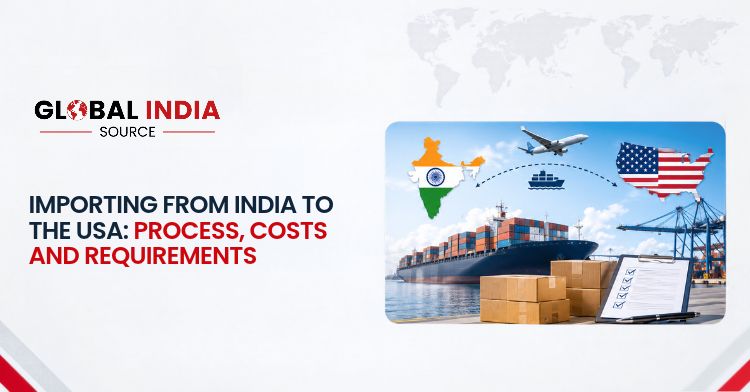
India has emerged as a major supplier of products to US firms due to its competitive prices, manufacturing expertise and diversified product range. Indian manufacturers cater to various industries with their expertise in textiles, handicrafts, machinery, leather products and engineering goods.
While importing products from India involves more than finding suppliers and placing orders, firms need to have an idea about shipping charges, duties and regulations related to the imported products, and documentation to make sure the goods can enter the new country without facing any trouble.
This guide will provide a complete step-by-step guide on how to import products from India to the USA.
Why Should Companies in the US Import Products from India?
Some reasons why companies in the US should consider sourcing products from India include:
- Competitive Production Costs: Indian producers provide competitive production costs in different sectors.
- Variety of Products: India is capable of producing various products including textiles, garments, jewelry, furniture, handicrafts, machinery, medicines and engineering products.
- Skilled Labor Force: Indian industries have a skilled labour force.
- Customization Option: Some of the producers provide private labeling and customizing services.
- Exporting Skills: Indian producers have experience working with foreign buyers and exporters.
These reasons make India a good option when looking for product suppliers. Nevertheless, companies need to assess suppliers, products, and other relevant factors before placing an order.
Steps Involved In Importing From India to America
To understand how to import products from India, there are certain steps that need to be taken. The following are some of the steps.
Step 1: Selection of Products and Market Research
The first step is to identify the products you wish to import. Conduct some market research to find out about the market in the US such as customer demand, competitors, selling prices, and how much money you will make from each product.
Check for the necessary requirements and regulations, the quality of the product, and whether the selling price will be able to cover the cost of procurement and shipping among other expenses.
Step 2: Finding Suitable Indian Suppliers
Find Indian suppliers using B2B marketplaces such as IndiaMART and TradeIndia, trade fairs, export councils and referrals.
Check out the credentials of the supplier including their business credentials, manufacturing capability, previous export experience, certification and customer review, among others.
Step 3: Negotiations of Pricing and Payments
Negotiate on unit price, MOQ, production period, packing and payment terms, among other.
Incoterms such as FOB (Free on Board) and CIF (Cost, Insurance, and Freight) should also be discussed and documented in the contract.
Step 4: Look at US Import Rules for Your Products
Every product requires some kind of special attention when importing into the USA. For example, there might be FDA requirements for food products, appropriate labeling for textile products and FCC compliance for certain electronics.
See if your products have any permits or certifications before shipping. A customs broker or compliance specialist will help you with that.
Step 5: Conduct Product Inspection Before Shipping
Conduct a product inspection before shipping the goods to check whether they are in line with the agreed specifications, such as dimensions, materials, quantity, packaging, labeling and finishing.
For bigger orders, it might be reasonable to hire an inspection company. It will save you from potential losses and problems.
Step 6: Pick the Right India to USA Shipping Method
Depending on the size, weight and other features of your shipment, you can choose a suitable shipping method from India to the USA.
- Express courier service: For samples, small parcels and urgent shipments.
- Air freight: If you need to ship high-valuable or urgent commercial consignment.
- Ocean freight: A cost-effective option for large and heavy shipments. You can choose FCL or LCL.
| Shipping Method | Indicative Transit Time |
| Express courier | 3–5 days |
| Air freight | 5–10 days |
| Ocean freight (FCL) | 25–40 days |
| Ocean freight (LCL) | 30–45 days |
These are approximate transportation estimates, not guaranteed delivery times. Actual timelines depend on routes, carrier schedules, and customs clearance.
Step 7: Preparation of Import Documentation
Preparation of proper documentation is key to customs clearance. The documents required to import goods from India into the United States include the following:
| Document | Purpose |
| Commercial Invoice | Shows product descriptions, quantities, values and seller details. |
| Packing List | Provides package details, weight, dimensions, and contents. |
| Bill of Lading | Transport document for ocean shipments. |
| Air Waybill | Transport document for air shipments. |
| Shipping Bill | Indian export customs declaration. |
| Certificate of Origin | Establishes the country where goods originate, when required. |
| Product-Specific Certificates | Required for regulated products, where applicable. |
| US Customs Entry Documents | Used to declare imported goods and assess duties. |
The US importer might also require an importer number and customs bond, as necessary.
In case of ocean shipment, the Importer Security Filing (10+2), also known as ISF, is usually required to be submitted at least 24 hours before the cargo is loaded onto a vessel bound for the USA.
Please check the documentation requirements with the customs broker prior to dispatch.
Step 8: Complete US Customs Clearance and Deliver the Goods
Upon arrival of the shipment to the United States, US Customs and Border Protection (CBP) will inspect the cargo before releasing it for entry into the country.
The steps involved include:
1. Filing of Entry: The importer or the customs broker provides necessary information about the shipment.
2. Documentation Checking: CBP reviews the information on the products, declared value, duty rates, and any other document related.
3. Duties Payment: The payment of custom duties is done by the importer.
4. Shipment Inspection: In some cases, CBP may inspect the shipment to confirm its contents.
5. Cargo Release: If all the requirements are met, CBP releases the shipment for delivery to the importer’s location.
The shipment will then be delivered to the importer’s warehouse or business premises after clearance.
Using a customs broker to handle the shipment can make the process much easier.
What Is the Duty on Imports When Shipping From India to USA?
Import duty is levied upon goods imported into the USA. It depends on the HTSUS number of the product, customs value, country of origin, and additional tariffs.
There is no uniform duty rate for all Indian products.
In 2026, there have been significant changes to US tariffs on Indian imports. On February 6, 2026, the USA and India announced a framework for an Interim Trade Agreement that included an 18% reciprocal tariff rate for Indian-origin products, subject to applicable exemptions. However, CBP subsequently announced that it would stop collecting additional duties imposed under the International Emergency Economic Powers Act (IEEPA) from February 24, 2026.
As of October 2026, a separate Section 301 measure imposes an additional 10% duty on specified products from India, subject to exemptions. This is not a universal rate for all Indian imports.
Before import:
- Find out your product’s HTSUS code.
- Check its applicable base duty rate.
- Consider additional tariff rates and exemptions.
- Determine the current duty rate by consulting a customs broker.
Use the US Harmonized Tariff Schedule for the latest product classification and rates of duty.
What Is the Cost of Shipping Goods from India to the USA?
The cost of shipping depends on the worth of products, the volume of shipment, mode of transport, and other factors.
Main costs are:
- Cost of the Product: The payment made to the producer in India.
- Freight: Charges for transportation by air/ocean/express.
- Import Duties: All import duties and fees.
- Insurance: Insurance of the goods against any possible losses.
- Customs Clearance: The costs of brokerage services.
- Handling and Storage: Costs for handling, storing, loading, and unloading.
- Domestic Transportation: Transport of goods within the country from the port/airport.
Calculate the estimated landed cost of goods rather than considering only the product price and transportation expenses.
What Is the Delivery Time for Shipment from India to the United States?
It will depend on the mode of transport, place of departure and arrival, shipping schedule, and customs clearance.
| Shipping Method | Approximate Transit Time |
| Express courier | 3–5 days |
| Air freight | 5–10 days |
| Ocean freight (FCL) | 25–40 days |
| Ocean freight (LCL) | 30–45 days |
These are indicative planning estimates, not guaranteed timelines. Production, documentation, customs inspections, and unexpected disruptions can extend delivery times.
Import Challenges in the Context of India – USA
Several difficulties may arise when managing international cargo shipments, including:
1. The difficulty in finding reliable suppliers and manufactures.
2. Lack of information on customs regulation.
3. Mistakes and errors in paperwork.
4. Products not meeting the agreed specifications.
5. Delays caused by various factors such as weather, port traffic and custom verification.
6. Miscommunication with suppliers, logistics companies, warehouses and brokers.
It is important to understand them to get ready for possible difficulties.
How to Import Internationally Successfully
Follow these recommendations to manage your imports more effectively:
- Check suppliers’ credentials and export experience before ordering goods.
- Obtain samples and check quality of the product.
- Research the requirements for import to the USA before manufacturing or shipping the goods.
- Fill out all documents correctly.
- Get quotations from several carriers before choosing a freight forwarder.
- Estimate the landed cost, including the product price, transportation, import duties, and delivery costs in the USA.
- Follow up the shipments and coordinate with carriers.
Conclusion
There are many benefits of importing products from India to the USA, as it gives businesses access to a wide range of products, manufacturers, and production facilities. At the same time, effective importing requires thorough preparation, starting with the selection of reliable Indian suppliers and continuing through the transportation of goods and customs clearance.
Understanding how to pay import duties, estimate shipping costs, prepare the required documentation, and identify products regulated by US laws can help businesses save time and money. Working with reliable suppliers and logistics service providers can make the international supply chain more efficient and dependable.
FAQs
How to import products from India to USA?
Firstly, you decide which product you wish to import as per the us market demand, then you contact with an Indian supplier who has the product you want to import, then get all the necessary information related to import procedures including quality control.
Is there an import licence required to import goods from India to the USA?
There is no general import license that is usually required when importing into the USA. But some products might require a permit or other kind of license from FDA, USDA, FCC and other relevant organizations.
What documents are required to import goods from India to the USA?
Usually, one needs to have a commercial invoice, packing list, B/L or AWB, Indian Shipping Bill, US customs documentation.
What are the costs of importing goods from India to the USA?
It depends on product costs, weight of the shipment, freight rates, custom duties, insurance, handling fees, etc. It is better to calculate the landed cost.
What are the duties applicable on Indian goods in the USA?
Duties are determined by HTSUS classification of the good, customs valuation, and tariffs applicable. Consult the latest USA tariff list instead of thinking that all Indian products have fixed duties.